Critique of Austrian Economics
Part II: The Legacy of Ludwig von Mises
Section XIV: Mises’ Pseudo-Axiomatic Praxeological Method
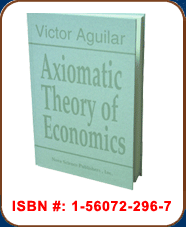
Mises’ praxeological method was a failure but it can at least be considered a forerunner of this author’s axiomatic method. While Mises never provides us with a concise statement of his postulate set, his repeated use of the phrase “action axiom” eventually leads one to believe that it means something like this author’s axioms one and two (1999, pp. xxiii-xxiv).27 And his regression theorem can be considered a special case of this author’s third axiom, which asserts that the value of the first unit of anything (not just money) changes each day by a proportion of the previous day’s value.
Thus, Mises came remarkably close to the starting point of Axiomatic Theory of Economics. Had he been a better mathematician he might have resolved his murky “action axiom” into a clear enumeration of what is known about marginal utility and a statement that value is a total ordering. Also, he might have recognized regression as an axiom applying to everything, not just a theorem applying only to money, though he would have first had to reject originary interest, since this axiom is a generalization of calculating interest as a percentage of the amount owed. Alas, he did not and economists had to wait fifty more years for a well-defined postulate set.
Pre-WWII Hayekians did not use very much math but, then, neither did Keynes or most other economists. After the war, at a time when mainstream economists were trying to emulate physicists, Austrians went math-free on the advice of Ludwig Mises ([1949] 1966). As Skousen has recorded (2001, pp. 290-291), this was largely a result of a sibling rivalry between Ludwig and his brother Richard, a famous probability theorist (1981).
Ironically, Richard Mises’ principle rival in probability was Kolmogorov, who gave an axiomatic foundation for the theory of probability (1956). Kolmogorov won; it is he, not Richard Mises, who is now considered the founder of modern probability theory. This is ironic because Kolmogorov’s axiomatic method is actually very similar to Ludwig Mises’ praxeological method.28 The difference, of course, is that Kolmogorov’s axioms are productive while Mises’ axiom, the proposition that humans act, is really just a platitude. Hoppe writes, “This axiom, the proposition that humans act, fulfills the requirements precisely for a true synthetic a priori proposition. It cannot be denied that this proposition is true, since the denial would have to be categorized as an action – and so the truth of the statement literally cannot be undone” (1995, p. 22). Thus, caught in this catch-22 situation, we must all be Misesians – or be dead. To acknowledge that people act (as opposed to what?) is to accept all of Mises’ theory, including originary interest and the works. This is rather like being asked, “Are you taking your antipsychotic medication?” There is no way to answer the question directly without implicitly admitting that one is psychotic.
Who ever heard of an axiomatic system with only one axiom? There are only postulate sets (e.g. Euclid has five, Kolmogorov has five and this author has three).29 But Ludwig Mises knew nothing about mathematicians and denounced them all, making no distinction between axiomatists like Kolmogorov and positivists like his brother. Thus having missed a splendid opportunity to team up with his brother’s rival,30 Ludwig Mises’ embryonic vision would lie dormant for half a century before the axiomatic method would find its champion in economics.
Meanwhile, Debreu (1959) made a half-hearted attempt to give an axiomatic foundation for the theory of economics. Unfortunately, by using grossly unrealistic assumptions, Debreu only succeeded in giving the axiomatic method a bad name.31 Keen writes:
It is almost superfluous to describe the core assumptions of Debreu’s model as unrealistic: a single point in time at which all production and exchange for all time is determined; a set of commodities – including those which will be produced in the distant future – which is known to all consumers; producers who know all the inputs that will ever be needed to produce their commodities; even a vision of “uncertainty” in which the possible states of the future are already known, so that certainty and uncertainty are formally identical. Yet even with these breathtaking dismissals of essential elements of the real world, Debreu’s model was rapidly shown to need additional restrictive assumptions (2001, p. 173). |
O’Driscoll and Rizzo (1985) have also argued against the “perfect information” assumption, as has Stiglitz (2003b, p. 25):
In effect, the Arrow-Debreu model has identified the single set of assumptions under which markets were (Pareto) efficient. There had to be perfect information, or, more accurately, information (beliefs) could not be endogenous, they could not change either as a result of the actions of any individual or firm, including investments in information. |
In sharp contrast to Debreu’s presentation of his assumptions, this author’s axioms are printed in plain language right up front before any theorems are deduced from them. There is no need for the prefatory phrase “In effect...” which Stiglitz found necessary because Debreu had been so opaque about his assumptions.
My assumptions are three:
| |
1) |
One's value scale is totally (linearly) ordered: |
| |
|
i) |
Transitive; |
p \(\leq \) q and q \(\leq \) r imply p \(\leq \) r |
| |
|
ii) |
Reflexive; |
p \(\leq \) p |
| |
|
iii) |
Anti-Symmetric; |
p \(\leq \) q and q \(\leq \) p imply p = q |
| |
|
iv) |
Total; |
p \(\leq \) q or q \(\leq \) p |
| |
| |
2) |
Marginal (diminishing) utility, u(s), is such that: |
| |
|
i) |
It is independent of first-unit demand. |
| |
|
ii) |
It is negative monotonic; that is, u'(s) < 0. |
| |
|
iii) |
The integral of u(s) from zero to infinity is finite. |
| |
| |
3) |
First-unit demand conforms to proportionate effect: |
| |
|
i) |
Value changes each day by a proportion (called 1+ j, with j denoting the day), of the previous day's value. j, with j denoting the day), of the previous day's value. |
| |
|
ii) |
In the long run, the j's may be considered random as they are not directly related to each other nor are they uniquely a function of value. |
| |
|
iii) |
The j's are taken from an unspecified distribution with a finite mean and a non-zero, finite variance (1999, pp. xxiii-xxiv). |
Kolmogorov also prints his axioms in plain language right up front before any theorems are
deduced from them:
| Let E be a collection of elements which we shall call elementary event, and Á a set of subsets of E; the elements of the set Á will be called random events.
|
| |
i) |
|
| |
ii) |
|
| |
iii) |
|
| |
iv) |
P(E) equals 1.
|
| |
v) |
If A and B have no elements in common, P(A+B) = P(A) + P(B)
|
| A system of sets, Á, together with a definite assignment of numbers P(A), satisfying Axioms I-V, is called a field of probability (1956, p. 2). |
Here, Kolmogorov does not introduce any new terminology (“field” is a well-known math word) but is comfortable with the standard language of mathematicians. Debreu, however, is not comfortable with the standard language of economists but instead introduces his many assumptions by way of a long and idiosyncratic vocabulary list. Thus, by the time we have learned Debreu-speak, we have lost track of all our new assumptions about these familiar-sounding words. We have entered the land of “blackboard economics” without having ever passed a signpost with a concise five-point list of axioms like Kolmogorov provides.
But debunking mainstream economics is beyond the scope of this paper – we are discussing Austrian Economics from 1930 to 1990.
27 It means something like it, but they are not identical. For instance, this author agrees with Caplan (1999, p. 825) when he criticizes Rothbard (1970, p. 267) for writing “not only are alternatives ranked ordinally on every man’s value scale, but they are ranked without ties; i.e., every alternative has a different rank.” This author writes, “Since the utility of a given stock is measured by the quantity of money which stands beside it on one’s value scale, U(s) is a mapping from the stock of a phenomenon one possesses to the money one associates with that stock” (1999, p. 99). Block (1999, p. 26) claims that “only cardinal utility can meaningfully be placed on an axis” while this author places utility thusly (1999, p. 101) while writing “[t]he stability of money does not imply that one’s value scale is cardinal; all phenomenon would have to be stable (independent of phenomena’s conformance to other definitions) for that to be true” (1999, p. 65).
28 This author writes, “In general, no more can be known about a specific situation than is known about all situations, that is, no more than what can be deduced from universal axioms” (1999, p. 89). Ludwig Mises would probably agree. If modern Misesians could get over their math phobia, they might also notice the similarity between the axiomatic and the praxeological methodologies. Hans-Hermann Hoppe wrote a book extolling Mises’ praxeological methodology and even went so far as to claim that “Mises improves the Kantian philosophy” (1995, p. 17). Four years later I showed him Axiomatic Theory of Economics (Aguilar 1999), which has a chapter on epistemology, including a section titled “The possibility of synthetic a priori knowledge.” His response was to flip through it and, immediately upon spotting some math equations, hand it right back to me. Murray Rothbard had the same response in 1993. Misesians complain that mainstream economists ignore them. But, by refusing to look at the work of a mathematician, they can hardly claim to have taken the high ground. If people want to be accepted, they must first learn to accept others. Skousen observes that “Today Böhm-Bawerk’s Karl Marx and the Close of His System is published by Marxists” (2001, p. 188). If only the Misesians could be so open-minded towards mathematicians!
29 Moise includes an introduction to the three geometries (1990, pp. 139-159) and a summary of the postulational method (1990, pp. 455-461) which are accessible to the general reader.
30 “The Meaning of Probability” (1966, p.106) is a stunning display of shooting oneself in the foot.
31 Times without number people have looked at the title of my book (1999), rolled their eyes and immediately chastised me for my “blackboard economics.” Obviously, they had mistaken me for Debreu.